



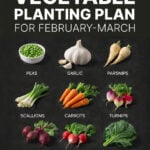


This simple spring vegetable planting schedule will help you grow a thriving vegetable garden with bumper harvests right through to the end of summer.
The planting schedule won't overwhelm you with every single vegetable you could possibly grow each month!
It gives you instead a balanced plan of :
- Quick growing veg
- Luscious leafy greens
- Super tasty roots
- Big fruiting vegetables
- PLUS lovely herb companion plants to keep you & your veggies healthy.

The schedule is suitable for USA zones 6-9 and the southern UK. There are key planting tips for each vegetable and links to step-by-step growing guides.
I hope the plan helps you enjoy a great crop of veg however tiny your garden.
For more help also read my must-know tips on starting a vegetable garden.
Table of Contents
February Planting Plan

February is really still a month for planning and preparing in the vegetable garden but you can get ahead planting :
- Peas
- Lambs lettuce
- Garlic
Peas

Garden peas are delicious and their early spring plants feed the soil with nitrogen for later vegetables like tomatoes and leafy greens.
Peas don't like hot sun so start planting in February for a late spring harvest.
You need to start seeds inside but they are easy to transfer out the month before last frost with DIY cloche.

To plant your peas :
- Fill DIY seed trays with 2 inches deep of damp but not soggy soil.
- Put one seed in each section.
- Plant seeds 1 inch deep.
- Peas germinate in 7-30 days.
- Plant out 2 to 3 inches apart.
Peas do well in pots or a bucket garden which you can move into shadier parts as the weather heats up in late spring.
For more tips : How To Grow Peas.
Lambs Lettuce

Lambs lettuce aka corn salad is a hardy salad leaf that is super healthy for both us and our soil. It's a great cover crop for cooler parts of the garden you won't otherwise plant until April or May.
To plant your lambs lettuce :
- Plant ¼ inch deep, 2 inches apart.
- Seeds will germinate in 2-3 weeks.
- Thin to 3-6 inches as needed.
- Start harvesting outer leaves once plants are 4 inches tall for a long cut & come again crop.
Garlic

Garlic is a very useful companion plant for vegetables as it repels bugs and protects soil from fungal disease.
It is also a tasty natural antibiotic so great in food and natural remedies.
February is really your last chance to get garlic planted for the year.
To plant garlic cloves :
- Plant cloves point upwards
- Clove point should be under 1 inch of soil so plant 2 inches deep
- Plant 6 inches apart for kitchen or 3 inches apart for pest control
- Harvest once leaves yellow.
For more tips : How To Grow Garlic
More February Vegetables

Other vegetables you can sow outdoors in February with plant protection are :
- Early beets / beetroot
- Parsnips
- Scallions / spring onions
Early March Planting Plan

Planting as much as we can in March gives our vegetable garden a great head start so prepare to be busy!
The first half of March is all about root vegetables and cabbages PLUS the first of our pretty pest control herbs :
- Carrots
- Turnips
- Radishes
- Spring Greens / Collards
- Chives
- French Marigolds
Carrots

Delicious young carrots can be grown in just 6 to 8 weeks so start getting them in now for summer salads.
Start with early growing varieties e.g. :
- Amsterdam Forcing
- Nantes 2
- Adelaide
With DIY frost protection you can also plant Paris Market and Baby Chantenay now rather than waiting until April.
To plant carrots :
- Make ½ inch deep trench in soil.
- Lightly water bottom.
- Thinly sprinkle seeds along trench.
- Cover with soil.
- Seeds germinate in 1-3 weeks.
- Sow a new trench every week or two for a long harvest.
- Thin seedlings once over 2 inches to 1.5 - 4 inches.
For more tips : How To Grow Carrots
Turnips

Young turnips are surprisingly delicious super foods with tasty edible leaves that the Italians eat as cime di rapa.
Turnips also work wonders in our vegetable garden as they can :
- Break up soil.
- Protect against fungal infections.
- Feed soil with nitrogen & nutrients.
To grow turnips :
- Sow seeds where they will grow e.g. in pot, bucket, vegetable bed.
- Plant seeds in ½ inch deep holes.
- Plant each seed 2.5 inches apart.
- Start harvesting leaves - lightly - when 10 inches tall, after 5 weeks.
- Harvest baby turnips at 6-7 weeks.
- Leave remaining plants for 10 weeks for full sized turnips.
For more tips : How To Grow Turnips
Collard Greens

Spring greens - collards in the USA - are quick growing, mild tasting cabbages you can grow easily from both seeds and kitchen scraps for cut-and-come-again leafy greens throughout spring.
To grow collards from stems :
- Put stem in bowl of shallow water.
- Stem should not be submerged.
- Freshen water every 2-3 days.
- Roots & new leaves will start appearing after a week.
- Plant out 4-7 days after first roots.

To grow collards from seed :
- Sow in DIY seed trays.
- Plant 1 seed per section.
- Plant seed ½ inch deep.
- Keep seedlings in plenty of light.
- Plant seedlings outdoors when :
- 3 inches tall
- Have 3-5 proper leaves
- Temperature above 45f/8c.
For more tips : How To Grow Collards
Radishes

Quick growing radishes can be ready in under 4 weeks and may be inter planted between slower growing vegetables without getting in the way.
Interplanted radishes help aerate the soil so air, water and key nutrients can reach your other vegetables.
The best quick radishes include :
- Cherry Belle
- Scarlet Globe
- French Breakfast
- French Dressing
- Sparkler
- Champion
To grow radishes :
- Sow directly outside.
- Sow seed ½ inch deep.
- Sow 10-20 seeds 1-2 inches apart.
- Seeds germinate in 5-10 days.
- Harvest after 3.5 - 4.5 weeks.
- Repeat sow after harvesting.
You can improve germination in early March by warming soil with a DIY cloche before planting.
For more tips : How To Grow Radishes
Chives

Pretty chives are good for gut health but are also a brilliant companion plant in a vegetable garden that can :
- Repel aphids
- Attract pollinators
- Increase vegetable yields
- And treat mildew & fungus!!
Chives can't be planted out until April but start them indoors in early March so they get straight to work protecting our veg once they go out.
To plants chives :
- Sow inside in small pots.
- Plant seeds ½ inch deep.
- Sow 5-7 seeds per pot.
- Keep in warm, sunny spot.
- Seeds will germinate in 7-21 days.
- Plant out at 2-4 inches after last risk of frost.
Chives are perennials so once planted will keep coming back each spring.
For more tips : How To Grow Chives
French Marigolds

French marigolds are another very pretty addition to your vegetable garden that really earn their keep as companion plants as they :
- Repel aphids & cabbage whites
- Attract predator pollinators
- Camouflage carrots from pests
- Control nematodes.
Like chives they need starting indoors.
To plant marigolds :
- Plant in DIY seed trays or pots.
- Sow 1 seed per section or 3 / pot.
- Sow seeds ½ inch deep.
- Seeds germinate in 4-10 days.
- Plant out after risk of frost.
For more tips : How To Grow Marigolds
More Early March Vegetables

Other vegetables to plant in early March with some plant protection are :
- Beets / Beetroot
- Broad beans
- Brussel Sprouts
- Celeriac
- Celery
- Parsnip
- Scallions / spring onions
You may not have enough space in a small garden for some of these slow growing vegetables like brussel sprouts that won't be ready until autumn.
Keep Planting
In early March you can keep planting :
Late March Planting Plan

In late March we can start sowing leafy greens directly outside including :
- Spinach
- Kale
- Lettuce
We can also use the last few weeks of possible frost to start indoors :
- Tomatoes
- Oregano
- Parsley
- Nasturtiums
Spinach

Spinach is a brilliant cut-and-come-again crop for long harvests. Keep it going longer by planting in containers which can be moved into cooler spots in late spring and summer.
To grow spinach :
- Sow seeds ½-1 inch deep
- Sow 2 inches apart.
- Seeds germinate in 7-10 days.
- Start harvesting baby spinach leaves - lightly - after 20-35 days.
For more tips : How To Grow Spinach
Kale

Kale can be another space-efficient leafy green crop you can grow and harvest quickly for lovely tender leaves.
To grow kale :
- Sow thinly in ½ inch deep trench.
- Kale germinates in 6-12 days.
- Start harvesting young tender kale leaves after 28 days.
- Leaves will re-grow throughout season after cutting.
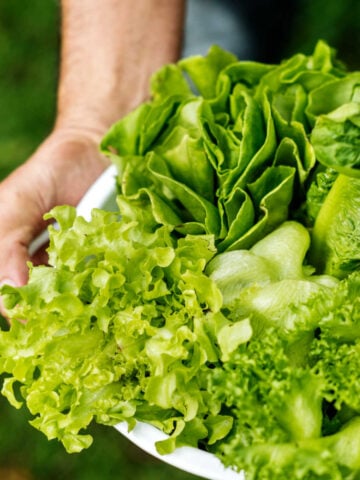
Lettuces

Lettuces are very quick growing veg and sown in March you can after 3-4 weeks start harvesting a cut-and-come-again crop that will last all summer.
Quick growing lettuce crops include :
- Salad leaf mixes
- Little Gem
- Oak Leaf
- Amaze
- Tom Thumb.
Generally loose leaf varieties will grow much quicker than heart lettuces.
To plant lettuce :
- Sow seeds shallowly at ⅛ inch.
- Sow ½-1 inch apart.
- Seeds germinate in 7-15 days.
- Keep thinning seedlings as they grow to 6 inches apart loose leaf & up to 12 inches for heart lettuces.
- Start harvesting loose leaf lettuce for repeat crops from 3-4 weeks.
For more tips : How To Grow Lettuce
Tomatoes

Tomatoes make great use of space in a small garden and you can get a bumper harvest with just a few rules.
The first rule is to plant tomatoes indoors in March so they are well established by planting out time.
- Sow in DIY seed trays.
- Sow 1 seed per module.
- Press seeds into damp soil.
- Cover lightly with more soil.
- Keep in bright warm window spot.
- Seeds germinate in 14 days.
- Turn trays daily for even growth.
- At 2-3 inches transfer to pots.
Plant out when temperature above :
- 60f/16c during the day
- 50f/10c at night.
Harden plants for a week by putting outdoors in day and bringing in at night.
For more tips : How To Grow Tomatoes
Oregano

Oregano is great in the kitchen and as a natural antibiotic in home remedies but also protects vegetables by repelling cabbage whites and mosquitos.
Start oregano seeds indoors in late March to go out in your vegetable garden once all chance of frost is gone.
You can grow oregano from clippings in jars of water or sow seeds :
- Warm soil of small pots before planting by covering with jar or clear plastic.
- Sow 3 seeds per small pot.
- Place seeds on damp soil.
- Seeds germinate in 10-21 days.
- Cover with plastic to speed germination in cooler homes.
- Plant out after last frost.
For more tips : How To Grow Oregano
Parsley

Parsley is another good herb to start inside in late March for the vegetable garden. It repels beetles and attracts predator pollinators who eat aphids.
You can grow parsley from cuttings in jars of water or sow seeds :
- Soak seeds in warm water for a day to speed germination.
- Warm soil before planting by covering with jar or clear plastic.
- Plant seeds in small pots.
- Plant seeds ½ inch deep.
- If home cooler than 68f/20c keep pot covered - but soil damp - until seeds have germinated.
- Once 2-3 inches high, harden off plants for a week outdoors.
- Then plant out in larger pots.
For more tips : How To Grow Parsley
Nasturtium

Nasturtiums are a super useful and cheerful companion plant in the veg garden that attract pollinators, repel pests and act as a trap crop to stop pests eating your vegetables.
To plant nasturtiums :
- Sow seeds ¾ inch deep.
- Plant 1-3 inches apart.
- Plant as first line of defence protection around vegetables.
- Seeds germinate in 2 weeks.
- Thin seedlings to 5 inches once a few inches high.
- Look out for slugs & snails plus aphids and manually remove.
For more tips : How To Grow Nasturtium
More Late March Vegetables

Other vegetables that you can plant in late March include :
- Onions
- Potatoes - first earlies
- Scallions / spring onions
Keep Planting In Late March
In late March continue planting :
April Planting Plan

In April you can carry on planting follow on crops for all your early & late March seeds but can also start growing:
- Chard
- Zucchini / Courgette
- Chamomile
- Borage
Chamomile and borage are both edible but also help feed and protect your veg.
Chard

Chard is easy to grow as a cut-and-come-again crop that keeps going from spring to late autumn. You can harvest young leaves in less than 8 weeks.
To plant chard :
- Sow seeds ¾-1 inch deep.
- Sow 3-4 inches apart.
- Seeds will germinate in 7-14 days.
- Start harvesting young leaves after 4 weeks or stems 4 inches long.
- Leaves will re-grow throughout season after cutting.
For more tips : How To Grow Chard
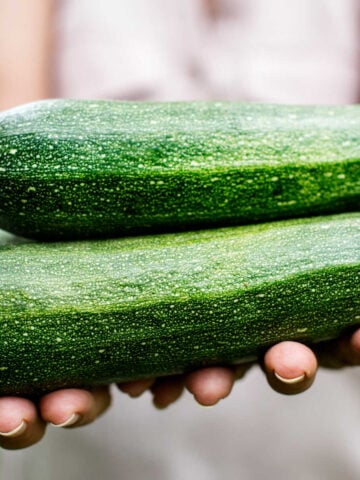
Zucchini / Courgette

Plant zucchini - courgette seeds indoors in April so ready to plant out in May for first fruit in June.
To plant zucchini seeds :
- Plant seeds in 3 inch pots.
- Plant one seed per pot.
- For small garden plant 6-8 pots expecting some loss.
- Plant seed on long edge, i.e. not flat, ½ inch deep.
- Seeds germinate in 7-14 days.
- Plant out when temperature at night above 55f/13c.
- Harden off over 7-10 days.
- Transfer to medium sized and finally 5 gallon container.
- Protect young plants from slugs.
- Keep 3-4 6 week old plants for a good harvest, trading others for e.g. cucumbers, peppers.
For more tips : How To Grow Zucchini
Chamomile

Pretty chamomile is a wonderful natural remedy - for everything from headaches and stomach pain to sinus relief and sore throats - that also works its magic in the vegetable garden as :
- Organic fungicide
- Nitrogen fixing fertiliser
- Aphid repellent.
To plant chamomile :
- Plant 4-6 seeds per small pot.
- Plant barely ¼ inch deep.
- Seeds germinate in 10-14 days.
- Plant out in May in larger pots or around edge of vegetable bed.
For more tips : How To Grow Chamomile
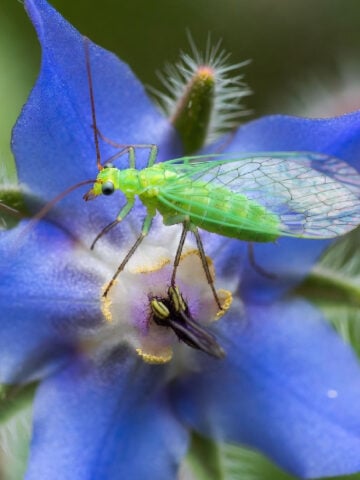
Borage

Borage is a pretty flowering edible herb that provides natural potassium fertiliser for your vegetable garden and especially peas, tomatoes and zucchini.
To plant borage :
- Sow ¼ inch deep.
- Sow 1 seed per small pot.
- Seeds germinate in 5-14 days.
- Plant out in May in containers or beds where you are growing peas, tomatoes or zucchini.
For more tips : How To Grow Borage
More April Vegetables

Other vegetables you can plant in April for autumn harvests include :
- Broccoli
- Kohlrabi
- Leeks
- Potatoes - second earlies
- Potatoes - maincrop
Keep Planting In April
You can keep planting in April :
May Planting Plan

By May you will already be enjoying crops from all your hard work in March so May is a good month to have some fun and plant some of the glamorous crops that taste amazing and transform your vegetable garden into a thing of beauty including :
- French Beans
- Runner Beans
- Summer Squash
May is also a good time to plant out :
- Thyme
- Basil
French Beans

French beans are the perfect addition to summer meals and taste so much better fresh from your garden.
To plant French beans :
- Plant beans out directly once temperature above 60f/15c.
- Or inside in 4-6 inch pot.
- Plant beans 2 inches deep.
- Plant beans or seedlings around a support structure e.g. bean pole tripod pushed well into soil.
For more tips : Growing French Beans
Runner Beans

Runner beans aren't as popular as French beans but that is because most of us won't have tasted how delicious they are fresh from the garden!
To plant runner beans :
- Sow beans once temperature reliably above 54f/12c.
- Plant beans 2 inches deep.
- Plant beans around a bean pole tripod or 12 inches apart along a bean pole A-frame.
For more tips : Growing Runner Beans
Thyme

Thyme is another handy kitchen herb for both recipes and remedies that also works hard in the vegetable garden attracting bees and repelling caterpillars and beetles.
It is slow to grow from seed but can be grown quickly from cuttings.
To grow thyme :
- Take 4 or 5 soft stemmed cuttings.
- Cuttings should be 2-3 inches long.
- Remove lower leaves.
- Put in small jar of water in warm sunny spot indoors.
- Change water every 2 days.
- Roots will appear after 10-14 days.
- Plant out in pots after 3 weeks.
For more tips : How To Grow Thyme
Basil
Tasty basil - another natural antibiotic - is a great companion plant for your tomatoes and helpful for lots of other vegetables including carrots.
To plant basil :
- Sow basil seeds ¼ inch deep.
- Sow inside in small pots or recycled seed trays.
- Seeds germinate in 5-14 days.
- Plant out in tomato beds or larger pots once temperature reliably above 59f/15c.
- Plant out plants 4-5 inches apart.
For more tips : How To Grow Basil
More May Vegetables

Other vegetables to plant in May are :
- Chicory
- Cauliflower
- Cucumbers
- Pumpkins
- Winter Squash
Keep Planting In May
Keep planting these vegetables in May :
Plus these pretty helpful herbs :
And there you go, a simple spring vegetable planting schedule for bumper harvests even in a tiny garden.
For more simple pratical gardening tips do follow me on Pinterest.
Image sources : Summer squash, Lamb's lettuce salad, runner beans under creative commons.
Leave a Reply